Thursday, March 1, 2012

Blackening the Bride

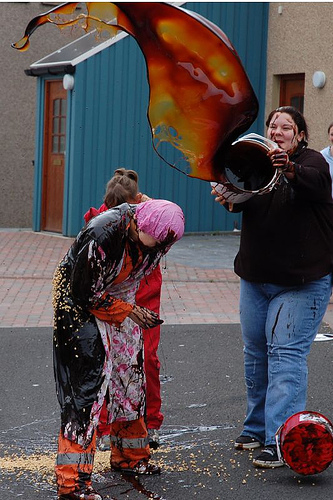
     Every wedding celebration has to have a few pre-wedding rituals to get things started. Some are a bit more odd than others, of course. In Scotland for example, the usual bridal showers that we have in America aren't customary. Instead, Scottish brides are put through a far more unorthodox agenda.

612851312_1ddc6aab621.jpg

     The day before a Scottish woman's wedding, she is taken out by her friends and family. During such an outing, she is taken by surprise and covered with all sorts of foul substances at some point. These substances include eggs, feathers, and various sauces. Afterwards, she is taken around town for all to see. In the end, it's clear that pre-wedding rituals can vary wildly, yet they all involve a great deal of laughs and fun.

By Julia Dankov

Thursday, February 16, 2012

Fiji's Wedding Dresses

     Every culture has its own style and way of dress. When it comes to wedding attire, it's very interesting to see what every part of the world deems customary for their wedding rituals. For example, the Fijian culture offers a selection of two quite specific, cultural wedding dresses, bias cut gowns and tapa cloth gowns. The designs of both are incredibly unique, making the tradition of wearing them truly special.


     These gowns can be seen being worn by brides all over Fiji. The bias cut gowns are long, silky dresses with a low-cut back. They come in all shapes, sizes, and colors, and can therefore be customized down to the very last stitch. Because of this, the phrase "it's perfect" can be applied wholeheartedly. The tapa cloth gowns are long, colorful dresses constructed of tapa cloth made from mulberry bark and decorated with geometric prints. They're a bit more exotic of the two Fijian wedding dress types, however for those looking to really stick to old traditions, it's the perfect choice. It's easy to see why both dresses are so popular among Fijian brides; they've been around for several centuries and have remained as beautiful as ever through the years.

By Julia Dankov

Saturday, February 11, 2012

Cake for the Couple!

     The sharing of the first slice of cake among the bride and groom is a tradition that's been around for quite a while. We've all heard of it, for it's not only extremely long-standing, it's immensely popular as well. The tradition originated in Rome several centuries ago, where people believed that it would signify the creation of a special bond. To this day, such a belief continues to stand strong.


     This activity usually takes place right after the wedding ceremony and at the very beginning of the reception. Once the cake is revealed, the bride and groom dig in together. They feed each other small pieces of the cake, smiling and laughing away. The wheat that's used to bake the cake is often symbolic of fertility and a fruitful union, and the overall sweetness of the cake is thought to offer sweetness to the marriage. It's a quite fun and sweet tradition because of such symbols, and can be seen all over the world because of this.

By Julia Dankov

Thursday, February 2, 2012

Father Daughter Dance

     When most people discuss father daughter dances, they refer to the wedding dance that takes place between a woman and her father on that woman's wedding day. This tradition has been around for several centuries, for its bittersweet and meaningful attributes have been touching the hearts of fathers for quite the while. Many choose to incorporate such a tradition into their weddings for this very reason.


     The father daughter dance is traditionally the very first dance that takes place at a wedding. Soft music plays as a young woman and her beloved father sway, enjoying a quite touching moment together. Such a moment means a lot, for it symbolizes a father handing his daughter over to his new son-in-law and losing his long-standing protective embrace over her. The tradition is very common in the Catholic religion, where special emphasis is put on the relationship between a girl and any fatherly figure in her life, let it be a father, grandfather, or uncle. Of course the tradition stands at large in many other religions and cultures, for it's a massive part in the majority of weddings all over the world nowadays.

By Julia Dankov

Thursday, January 26, 2012

Chinese Wedding Night Ritual

     The night after a wedding celebration is that of one filled to the brim with smiles, laughs, and love. In certain cultures though, the night after a wedding is far more important and means much more. Take the Chinese culture, for example. After a traditional Chinese wedding, the couple in question is to follow special rituals and customs throughout the duration of the night. Each ritual has a specific reason to it and symbolizes quite the lot.


     After a Chinese couple's wedding celebration ends, the couple is put into a room in which they spend the entire remainder of the night. This room will be filled with lit dragon and phoenix candles, which are believed to drive away evil spirits and ensure a healthy and undisturbed marriage. The newlyweds spend their night drinking wine from two glasses tied together by a red string. This symbolizes the formal wedding vow in Chinese culture. They also feast on all sorts of food, including half-raw dumplings. These dumplings, although not very tasty, ensure happiness and indicate family prosperity. In between it all, small games, dances, and other such activities are done by the couple throughout the entire night. All in all, the newlyweds simply enjoy each others company, which is ultimately the most important factor of the night. 

By Julia Dankov

Thursday, January 19, 2012

Old, New, Borrowed, Blue

     Something old, something new, something borrowed, and something blue; does this sound familiar? Most couples would say so. The tradition of having the bride wear something old, something new, something borrowed, and something blue on her wedding day is quite popular. It dates back to Victorian times, when it was invented to offer a few symbolical signs of happiness, health, wealth, and more. Nowadays, as the purpose of the tradition remains the same, many couples choose to incorporate it into their wedding.

     Something old should traditionally come from a happily married woman, so as to transfer happiness and wisdom. Something new should be the wedding gown or other such apparel, symbolizing a new beginning. Something borrowed should usually be an object of gold, so as to guarantee wealth and fortune. Something blue signifies the heavens and true love. Put all together, the objects are a symbol of all that a married couple should ever hope for. This tradition is a sweet and fun way of portraying such hopes, and so it's quite popular all over the world as well as in my own family!

By Julia Dankov

Thursday, January 12, 2012

The Flower Girl

     Young, innocent, whimsical, those are all words people have come to associate with flower girls. It is because of this that they symbolize so much at weddings. It is also because of this that they have been around for so long, for they have been incorporated into just as many weddings nowadays as ever. When you think about it though, you come to wonder how the tradition started in the first place.


     In medieval times, it was customary for royal weddings to have large amounts of particularly young guests. It became tradition of sorts for these young guests to bring herbs and flowers of all kinds with them to scatter before the wedding reception as a way of adding a bit of sweet and subtle beauty to the marriage ceremony. The flower girl we see nowadays mainly evolved from such traditions seen at Victorian weddings, back in the mid seventeenth to early eighteenth centuries. Then, a young girl was chosen to walk down the aisle right before the vows and exchanging of the rings wearing a white dress with a colored sash, carrying a decorative basket filled with flower petals. This same tradition is seen quite commonly all over the world now, as many people cannot help but wish to incorporate such a sweet and innocent image into their wedding celebrations.

By Julia Dankov